Foolproof Prime Rib Roast with Garlic Herb Crust
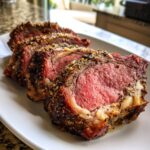
This recipe translates professional technique into a simple method for cooking a standing rib roast. You will achieve a juicy, tender roast with a flavorful herb crust, perfect as a show-stopping dinner idea for any special occasion.
- Prep Time: 20 min
- Cook Time: 1 hr 45 min
- Total Time: 2 hr 5 min
- Yield: 6 servings 1x
- Category: Main Course
- Method: Oven Roasting
- Cuisine: American
- Diet: Low Fat
Ingredients
Scale
- 1 (4 to 6 pound) standing rib roast (prime rib roast), 2 to 3 ribs
- 3 tablespoons kosher salt
- 1 tablespoon freshly ground black pepper
- 1 tablespoon dried thyme
- 1 tablespoon dried rosemary
- 6 cloves garlic, minced
- 1/4 cup olive oil
- 1/4 cup unsalted butter, softened
- 1 tablespoon Dijon mustard
- 1 teaspoon Worcestershire sauce
Instructions
- Remove the roast from the refrigerator 2 to 3 hours before cooking. Let it come closer to room temperature; this helps the roast cook evenly.
- Prepare the herb crust: In a small bowl, combine the minced garlic, olive oil, softened butter, Dijon mustard, Worcestershire sauce, salt, pepper, thyme, and rosemary. Mix until you have a thick paste.
- Pat the entire surface of the rib roast dry with paper towels. This step is key for a good crust.
- Rub the garlic herb paste evenly over the entire surface of the roast.
- If your roast has bones, ask your butcher to separate them and tie them back onto the roast with kitchen twine. This allows the roast to sit level and cook uniformly.
- Preheat your oven to 450 degrees Fahrenheit. Place the roast, fat-side up, on a rack in a sturdy roasting pan.
- Roast at 450°F for 15 minutes. This initial high heat helps sear the outside.
- Reduce the oven temperature to 325 degrees Fahrenheit. Continue roasting until the internal temperature reaches your desired doneness. Use a meat thermometer inserted into the thickest part of the meat, avoiding bone.
- For medium-rare (the target for a perfect prime rib roast), remove the roast when the thermometer reads 125°F.
- Remove the roast from the oven. Tent it loosely with foil and let it rest for at least 20 minutes before carving. The internal temperature will rise about 5 to 10 degrees during this rest period.
- Remove the twine and slice between the bones to serve. Use the pan drippings to make a simple pan gravy.
Notes
- For edge-to-edge uniform doneness, consider using a low-and-slow method, starting at a lower temperature (like 250°F) until the internal temperature is about 10 degrees below your target, then finishing at 450°F for 10 minutes to crisp the crust.
- Always use a reliable meat thermometer; guessing the internal temperature is the fastest way to ruin an expensive cut like this ribeye roast.
- If you prefer a dry brine, skip the butter rub and coat the roast heavily with salt and pepper 24 hours ahead of time, leaving it uncovered in the refrigerator. Apply the garlic herb mixture just before the initial high-heat sear.
Nutrition
- Serving Size: 6 oz cooked meat
- Calories: 450
- Sugar: 0
- Sodium: 450
- Fat: 30
- Saturated Fat: 12
- Unsaturated Fat: 18
- Trans Fat: 0
- Carbohydrates: 1
- Fiber: 0
- Protein: 42
- Cholesterol: 140
Find it online: https://kitchenslang.com/foolproof-rib-roast-master-trick/